
Researching Resilience: Can Therapy Dogs Help Build a More Resilient Healthcare Workforce?
Published:
Healthcare workers spend their days caring for others. But who cares for the people who do the caring? Nurses, physicians, technicians, and other frontline healthcare professionals face demanding work environments that can affect stress, emotional well-being, and their ability to cope throughout the workday.
Building a more resilient healthcare workforce means organizations need to explore meaningful, evidence-based ways to support the people at the heart of healthcare.
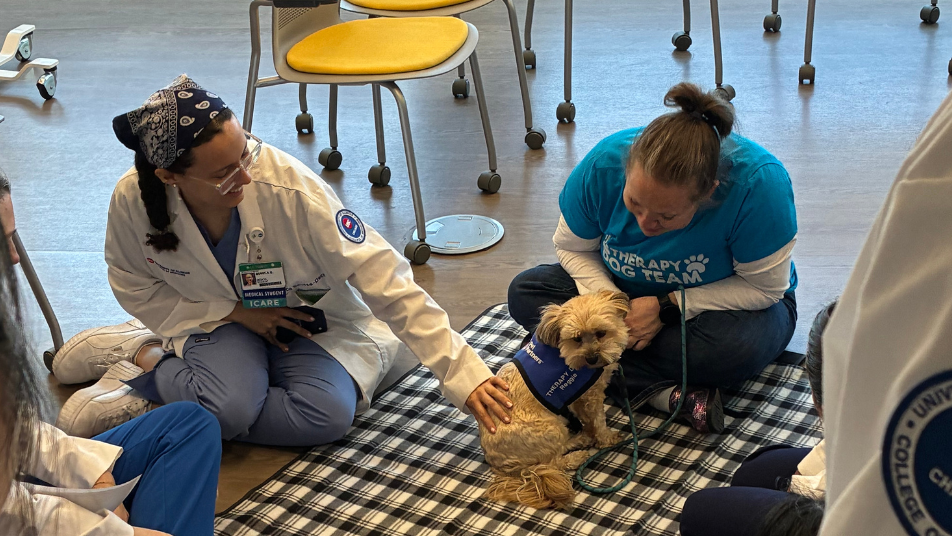
A therapy dog can create a welcome pause during a demanding shift. A nurse might stop between patients to say hello. A physician may take a few minutes to interact with a therapy animal after a difficult case. A healthcare worker may simply experience a moment of calm or happiness.
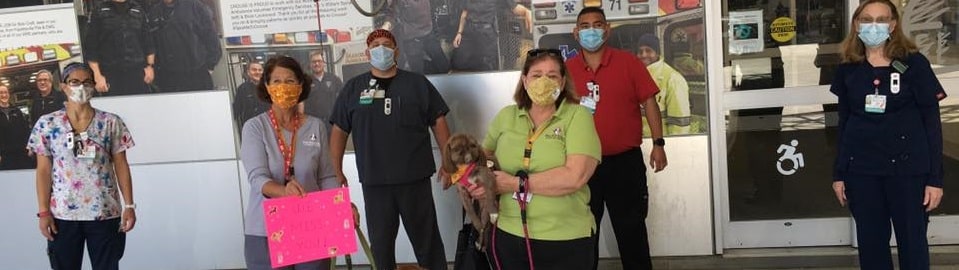
“Monday blues? Not when Ardee shows up! On a day when no one really wants to be at work, Ardee is seriously the best, always bringing the energy and making Mondays a little easier. Thank you for always being so consistent and for making a difference in the lives of our patients and staff. Your dedication, reliability, and positive impact are truly appreciated. Thank you for everything you do!“
– a recent thank you message received from hospital staff
While these interactions are brief, research suggests therapy animal visits can have positive effects on healthcare workers’ experience right away.
But there is still much to learn about how therapy animal interactions may support healthcare workforce resilience.
That is why Pet Partners is conducting new research with support from the Baxter Foundation.
The research will examine the impact of therapy animal interactions on healthcare workers, including changes in:
The study will also explore healthcare workers’ lived experiences with therapy animals in demanding clinical environments, and what role they think therapy animals play in supporting emotional well-being and resilience.
This research will help us better understand where therapy animal interactions may fit within a broader approach to healthcare workforce well-being and resilience.
Research has been part of Pet Partners’ story from the beginning.
In 1977, a group of veterinarians and medical professionals established the Delta Society with a primary purpose: conducting research on the human-animal bond. These human-animal connections, known as animal-assisted interventions (AAI), involve intentionally incorporating animals into structured interactions or interventions. The goal is to support health, education, or human service goals.
The founders recognized that anecdotes alone were not enough to establish the significance of the human-animal bond. Scientific research was needed to better understand how animals affect people’s lives. The organization ultimately became known as Pet Partners in 2012.
Nearly 50 years later, that commitment continues.
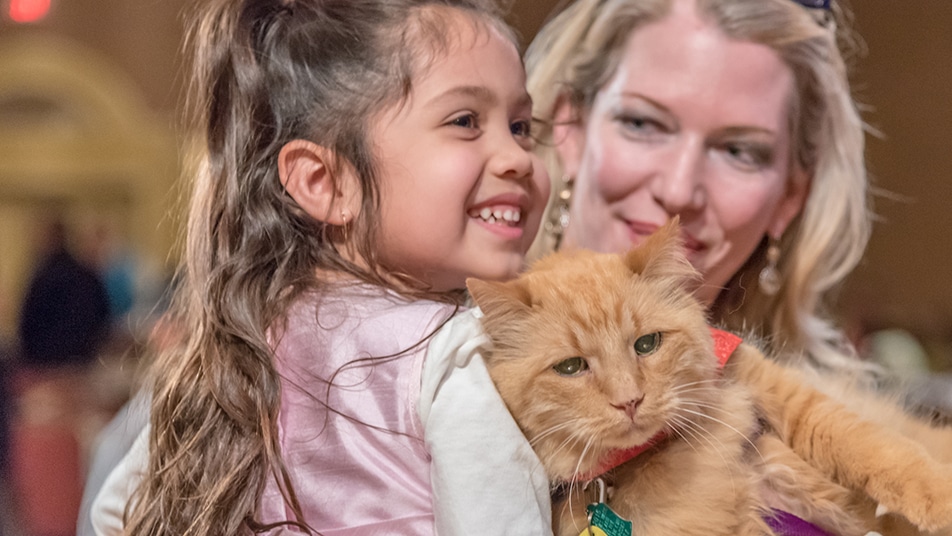
In one previous research project, Pet Partners partnered with a leading cat-focused company. We conducted an in-depth study of the cat-human bond and the impact of therapy cats. The research combined surveys and interviews with therapy animal volunteers, known as “handlers,” and staff from facilities where therapy cats visit.
The study provided valuable insight into the experiences of therapy animal handlers, the relationships between cats and their handlers, and the experiences of people receiving therapy cat visits. It also demonstrated the value of combining quantitative and qualitative research to better understand animal-assisted interventions.
Now, we’re bringing that research experience to an important question in healthcare. How do therapy animal interactions affect healthcare workers? And further, what does it take to bring workforce-focused animal-assisted intervention programs to real-world healthcare environments? The research will also explore feasibility, adoption, accessibility, and sustainability. It will examine how experiences may differ across healthcare settings, units, professional roles, and shift types. The findings will inform recommendations and best practices for workforce-focused AAI.
Research is only part of the equation. For healthcare organizations interested in bringing therapy animal visits to their workforce, implementation matters, too.
Hospitals and other healthcare facilities need to consider workforce needs, scheduling, accessibility, safety, program coordination, and sustainability when developing a staff-focused therapy animal program.
Pet Partners’ Facility Toolkit provides practical guidance for organizations interested in starting or growing a therapy animal visitation program, including considerations for creating a safe, effective, and well-managed program.